Piping
Spool handling and temporary support — the hours between landed and supported
The period in which a spool has been released by the crane but does not yet have the supports it was designed to have, why that state has no design behind it, what has to be established before the hook comes off, and why Friday afternoon is when pipe ends up on the floor.
Standards referencedASME B30.9ASME B30.26EN 12811-1
Most of what is written about pipe supports describes the finished condition — the shoe, the guide, the anchor, the spring, each selected for a load case and drawn on a support drawing. That is the subject of support design and it assumes something that is not true during construction.
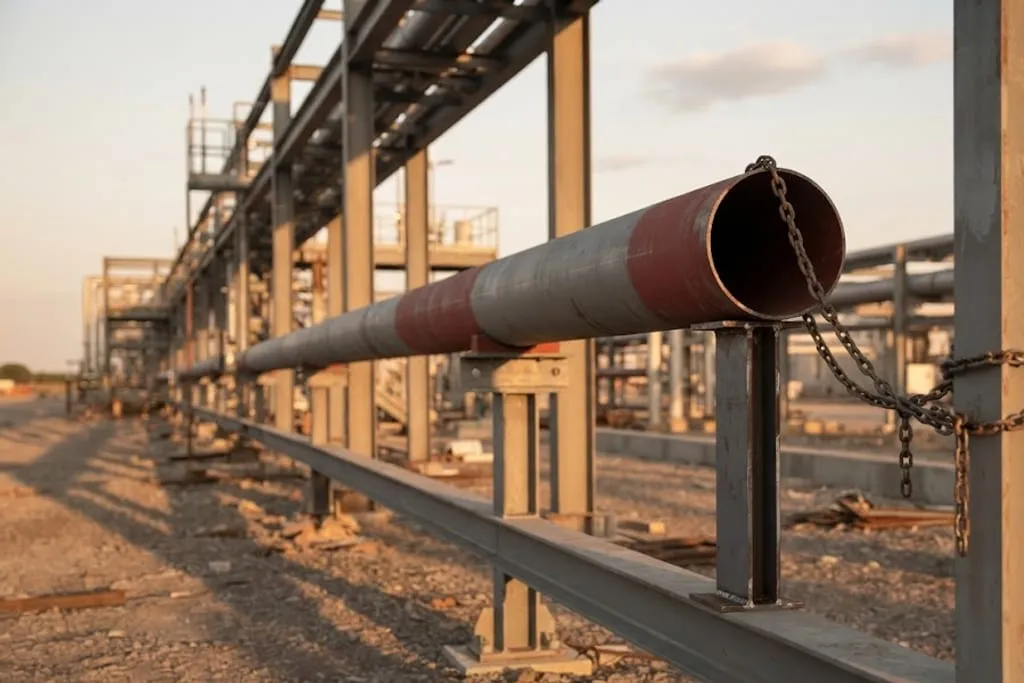
It assumes all the supports are there.
Between the moment a spool is landed and the moment its supports are fitted, the line is in a condition nobody designed. The support scheme does not cover it, because the support scheme describes the completed system. The lift plan does not cover it either, because the lift plan ends when the load is set down. The gap belongs to the supervisor.
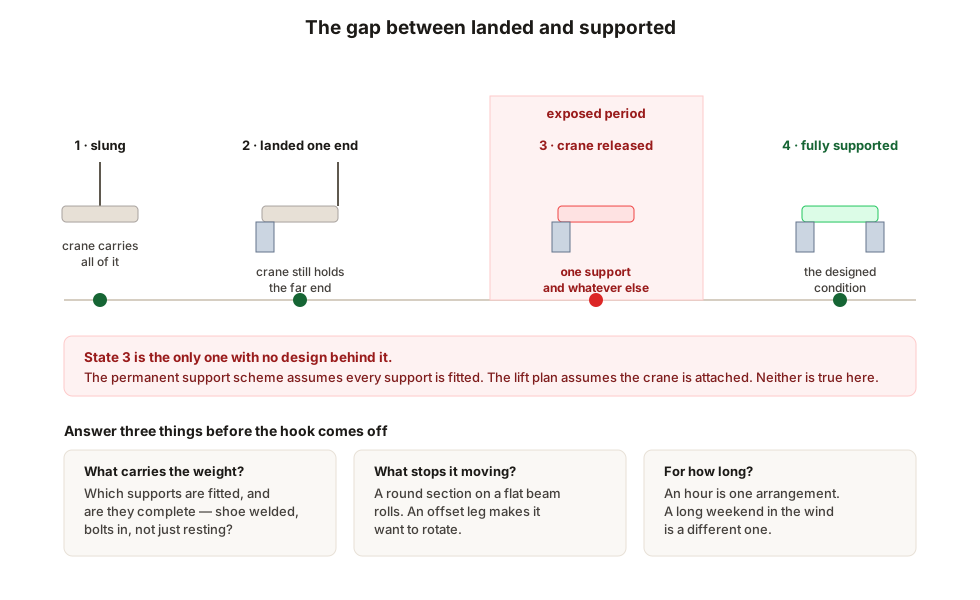
Three questions before the hook comes off
Not a procedure, a habit. They take about thirty seconds and they are the difference between a considered arrangement and an assumption.
What is carrying the weight? Which supports are actually fitted, and are they finished? Fitted and complete are not the same thing. A shoe positioned but not welded will carry vertical load perfectly well. A clamp with the bolts in finger tight looks identical to one that is done up.
What is stopping it moving? Weight is rarely what drops a spool. Movement is. A round section sitting on a flat beam will roll given a nudge, a gust, or somebody leaning a ladder on it. A spool with an offset leg is not simply heavy — it is carrying a turning moment and is actively trying to rotate.
For how long? An arrangement you are standing beside for an hour is a different proposition from the same arrangement at five o’clock on a Friday.
Centre of gravity is not the middle
The single most useful habit in handling spools is to stop assuming the centre of gravity is halfway along.
It is halfway along for a straight run of constant bore. Almost nothing else is a straight run of constant bore. A long-radius elbow at one end, a valve, a flange pair, a reducer — each moves the centre of gravity, and the effect is larger than people expect because the heavy items are usually at the ends rather than distributed.
This matters twice. Once while slinging, where a misjudged centre of gravity makes the spool tilt as it leaves the stand. And once while supporting, where it decides whether the spool is stable on the supports that happen to be fitted.
Handling before the lift
Damage done on the ground is paid for at height.
- Bevels. A machined weld preparation is the most easily damaged part of a spool and the most expensive to repair in position. Protect it, and do not let a spool be dragged on its ends.
- Flange faces. Same argument. A covered face stays usable.
- Slinging points. Round slings on painted pipe, not chain. Softeners at edges. Nothing passed through a branch or a flange bolt hole.
- Stacking. Spools stacked without dunnage deform small bore and damage coating, and the one at the bottom is always the one needed first.
None of this is sophisticated. It is simply the part of the job where carelessness is cheap at the moment it happens and expensive three weeks later.
When to ask for help
Most temporary arrangements are obvious to an experienced supervisor and need no calculation. Some are not, and the ones that are not share features worth recognising:
| Feature | Why it needs checking |
|---|---|
| Long unsupported spans | Deflection and the stress it induces, not just stability |
| Loading onto structure not designed for it | Temporary load on a platform, handrail or grating |
| Spools that must stand for an extended period | Wind, thermal movement, other trades working nearby |
| Anything supported off scaffold | Scaffolds are designed for access loads, not pipe loads |
That last one deserves emphasis. A scaffold is designed for a duty, with a load class behind it under EN 12811-1, and that duty is people, tools and a modest quantity of materials. It is not designed to hold pipework, and using it that way is a genuinely common way to overload one without anybody intending to.
Check your understanding
6 questions. Nothing is recorded — this is just for you.