
Piping
Lift plans and rigging basics — sling angle, centre of gravity, and the reasons to stop
What a lift plan has to state before anybody touches a spool, why the tension in a sling leg is not the load divided by the number of legs, how an offset centre of gravity behaves, and the short list of conditions under which a supervisor stops a lift regardless of who is waiting.
Standards referencedASME B30.9ASME B30.5ASME B30.26ISO 12480-1
A piping supervisor is not the appointed person for lifting operations, does not select the crane and does not write the load chart. What they do is work to the outputs of all three, every day, usually several times a day, and the decisions that go wrong are rarely the crane’s.
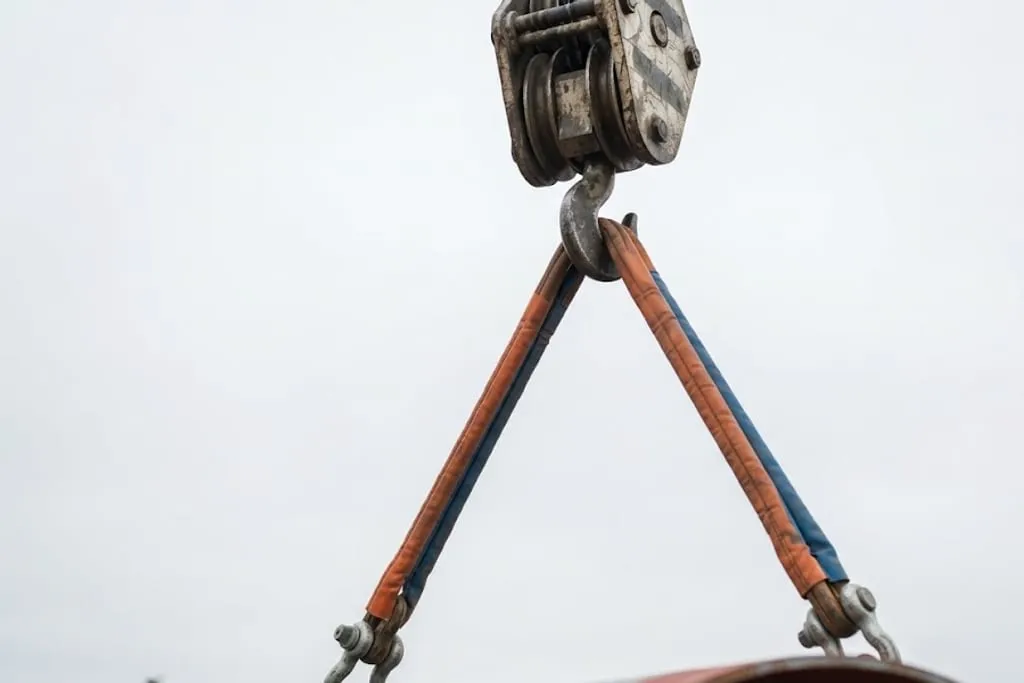
This topic is the supervisor’s share of it.
What a lift plan has to say
Before anybody touches a spool, four things have to be known and agreed, and the first one is the one most often guessed.
The weight. Not estimated by eye. A fabricated spool with a valve in it is routinely half as heavy again as people guess, and the guess is always low.
The centre of gravity. Where it actually is, not where the spool looks balanced.
The method. Sling type, configuration, lifting points, and the hardware between the hook and the load.
The people. Who is the operator, who is the slinger, who is the signaller, and who may stop it. Named, out loud, before it starts.
Sling angle, which is the arithmetic that matters
This is the one piece of rigging arithmetic worth knowing by heart, because it is the one that is wrong on site most often, and because the error always runs in the dangerous direction.
The intuition people carry is that two legs share the load, so each leg takes half. That is true only when the legs are vertical, and on a spool with two lifting points at the same height they are never vertical. They spread, and as they spread the tension in each leg rises — quite slowly at first, then sharply.
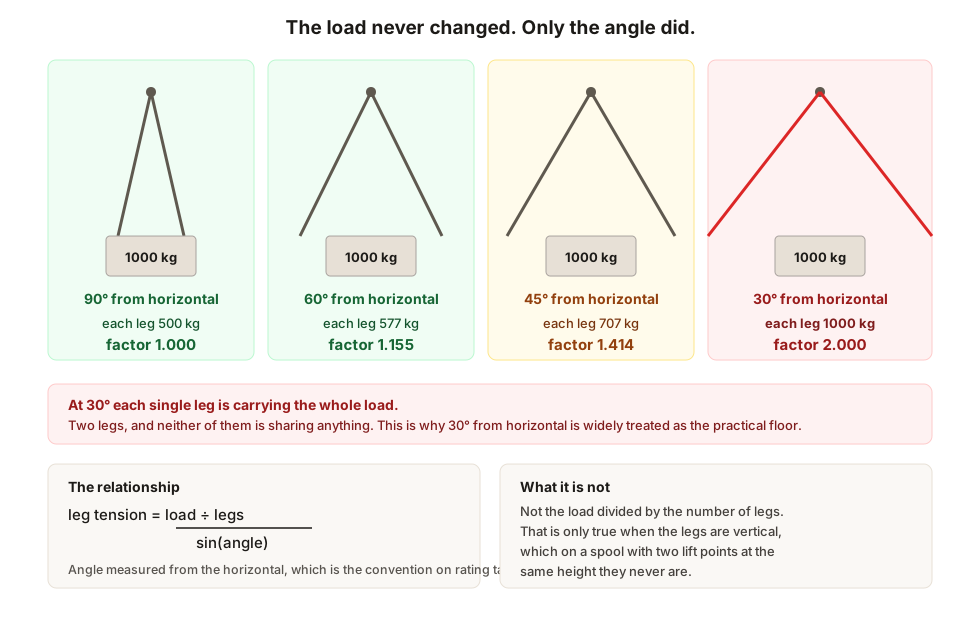
The relationship, with the angle measured from the horizontal as the rating tables do:
leg tension = (load ÷ number of legs) ÷ sin(angle from horizontal)
Which gives the factors worth remembering:
| Angle from horizontal | Factor | On a 2,000 kg load, per leg |
|---|---|---|
| 90° (vertical) | 1.000 | 1,000 kg |
| 60° | 1.155 | 1,155 kg |
| 45° | 1.414 | 1,414 kg |
| 30° | 2.000 | 2,000 kg |
At 30° each leg is carrying the whole load, which is why 30° is treated almost everywhere as the practical floor. Below it the numbers get ugly very quickly.
Centre of gravity on a spool
A spool is an awkward lift in a specific way: its weight is concentrated at discrete points rather than distributed along it.
A long-radius elbow, a flange pair, a valve — each is a lump, and the lumps are usually at the ends. So the centre of gravity moves further from the midpoint than an eye estimate suggests, and the consequences arrive in two places.
While slinging. If the hook is not over the centre of gravity, the spool tilts as it comes off the stand. That is not merely untidy — it is the moment the sling can slide, the moment the load swings, and the moment somebody puts a hand out.
At the hardware. Angular loading is what an offset centre of gravity produces, and angular loading is what rigging hardware is least tolerant of. An eye bolt loaded off-axis loses most of its rating. A shackle side-loaded does the same. Both will look entirely normal while doing it.
The reasons to stop
Short, and worth being explicit about with a crew, because a stop authority nobody has ever used does not exist.
- The load does not behave as expected as it is taken up — it tilts, swings or the sling slides.
- The weight turns out to be different from the plan.
- Wind rises beyond what the tag lines can control.
- Anybody enters the exclusion zone.
- Visibility between the signaller and the operator is lost.
- Anything at all is not as briefed.
Anybody in the team may stop a lift, and that includes the slinger and the banksman, not only the supervisor. The reason is practical rather than procedural — the person who first sees the problem is very often the one standing closest to it and holding the least rank.
What stays with the appointed person
For clarity, because the boundary gets blurred and a supervisor who takes on the wrong half of it is exposed:
| Theirs | Yours |
|---|---|
| Crane selection and configuration | Knowing the weight of what you are asking to be lifted |
| Load chart, radius, ground bearing | Preparing the load — bevels protected, nothing loose on it |
| Outrigger and mat requirements | Access, exclusion zone and who is in the area |
| Authorising the lift plan | Briefing your crew on it, and stopping if it changes |
The failures in practice are almost always in the right-hand column.
Check your understanding
6 questions. Nothing is recorded — this is just for you.