Piping
Erection sequence and constructability — why the isometric order is not the build order
Why the number on an isometric says nothing about what has to be built first, how access is lost and regained, the dependencies that decide a piping sequence, and the habit of working backwards from the date that cannot move rather than forwards from today.
Standards referencedEN 12811-1ISO 21508
Ask a new supervisor how they will erect a rack and a surprising number will answer with a drawing number. The isometrics are in a folder, the folder is in order, and the order looks like a plan.
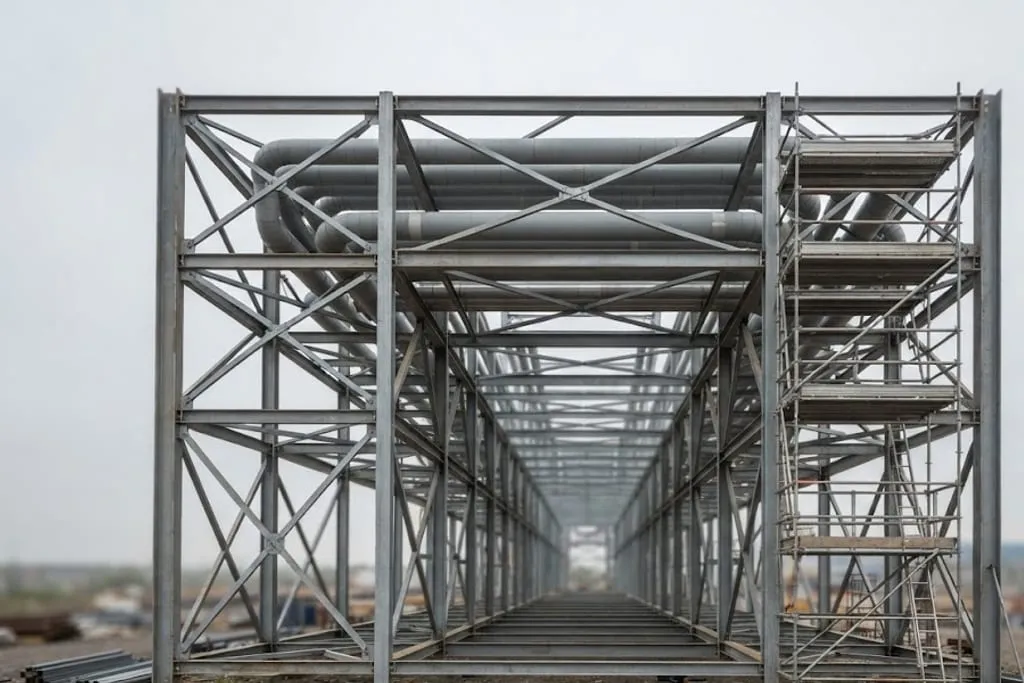
It is not a plan. An isometric number is a filing reference. It is allocated by the drawing office from the line number and the sheet count, and it carries no information at all about what has to exist before what. Building in isometric order means building in the order the drawings were registered, which is a coincidence rather than a sequence.
The sequence is a separate piece of thinking, and it is the first real responsibility of the job.
What actually decides the order
Four things, roughly in the order they bite.
Access. What can be reached, from what, and for how long. This dominates everything else on a congested unit and is the one most often left out, because access feels like a condition of the site rather than a thing with dates.
Physical dependency. What must be in place before this can be. Equipment before its connecting pipework. Steel before what hangs from it. Foundations cured before anything is set on them.
Fixed dates that belong to someone else. The tie-in window, the equipment delivery, the hand-over of an area by civil. These cannot be negotiated by the piping crew and so they are constraints rather than plans.
Resource. Crane availability, welder numbers, how many fronts can honestly be run at once. Usually the least constraining of the four, which surprises people, because it is the one that gets discussed most.
Top down, not bottom up
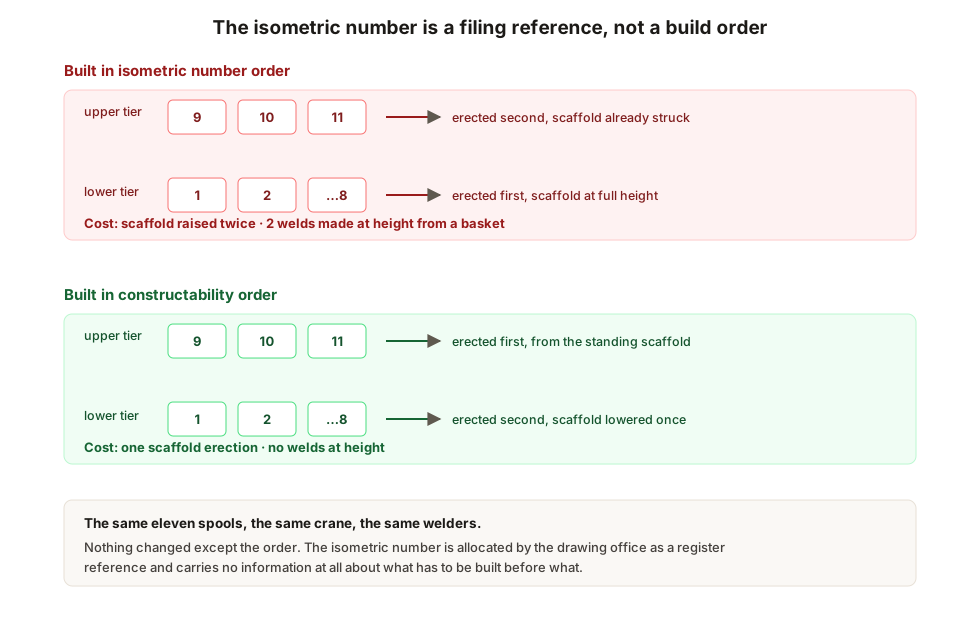
The rack example above is worth holding on to, because the instinct runs the wrong way.
People build racks from the bottom because that is how things are built generally — you cannot put the first floor on before the ground floor. But a pipe rack is not supporting itself that way. The steel is already there. Every tier hangs off structure that exists before any pipe arrives, so the lower tier is not holding the upper one up and there is no structural reason to build in that order.
What there is, is a scaffold. It gets erected once to full height, and if the work runs downwards it comes down progressively as the work finishes. Run the work upwards and it has to be struck and raised again, and whatever is left at the top gets done from a basket at twice the cost and half the quality.
Backwards from the date that cannot move
Most dates on a construction programme are negotiable in practice, whatever the contract says. One usually is not: the shutdown or tie-in window, because the plant has told its customers when it is coming back.
So the sequence is built backwards from it. If the window opens on the 14th, then everything that must be complete before it opens has a date set by the 14th and not by convenience: spools fabricated, fit-up dry-run, consumables drawn, scaffolding in, isolations agreed, welders qualified and continuity current.
Doing it forwards produces a programme in which the preparatory work finishes “before the window”, which is not a date and will not be treated as one.
The three-week look-ahead
The master programme belongs to the planner and usually to the client. It is not the supervisor’s instrument, and arguing with it is rarely time well spent.
The instrument a supervisor actually controls is the three-week look-ahead: what will be worked on, by whom, with what access and what materials, for the next three weeks. It is short enough to be true and long enough to let a missing item be chased before it stops the job.
Its real function is not planning. It is finding out what is missing while there is still time to get it, which is a different activity and the one that separates a crew that works from a crew that waits.
Constructability, read off a spool list
Reading a spool list for constructability is a learnable habit. Three questions per spool:
| Question | What it exposes |
|---|---|
| What has to exist before this can go up? | Physical dependency — foundations, steel, equipment |
| What does this block once it is up? | The spool that makes a hanger unfittable, or a valve unreachable |
| How will it be supported before its permanent supports are in? | Temporary works, and the weekend problem |
The second one is the one people miss. A spool that is easy to erect and makes the next three difficult has cost more than it saved, and the only moment to notice is before it goes up.
Where interfaces predictably fail
Piping sits late in the dependency chain, which means other people’s slippage arrives as the piping crew’s problem. The pattern repeats across projects:
- Civil late. Foundations not cured, areas not handed over. Accumulates upstream and lands on piping.
- Equipment arriving before its foundation. Now it is stored, double handled, and its connecting pipework is held.
- Electrical and piping wanting the same rack at the same time. Both are right and neither is scheduled against the other.
- Insulation and painting following too closely. A line that is insulated before it is tested will be stripped.
None of these are solved by the piping supervisor. All of them are survivable by the piping supervisor who has a second front prepared, which is what the sequence is for.
Check your understanding
6 questions. Nothing is recorded — this is just for you.