Piping
Access, operability and maintenance space — what the plant is judged on afterwards
Valve reach and stem orientation, why a chain operator is a confession, platforms and the dead-end with one ladder, headroom, bundle pull and rotor withdrawal, drop-out areas and davits, and the model review that is the last chance to find any of it.
Standards referencedOISD-STD-118ASME B31.3API 686ISO 45001
A unit is judged on operability after handover and almost never before it. The design is reviewed for process, for stress, for materials and for clashes — and the question of whether a human being can reach, read, operate and remove things gets asked, if at all, by the people who then have to live with the answer.
Most of what follows costs nothing at design stage and is close to unfixable afterwards.
Valves
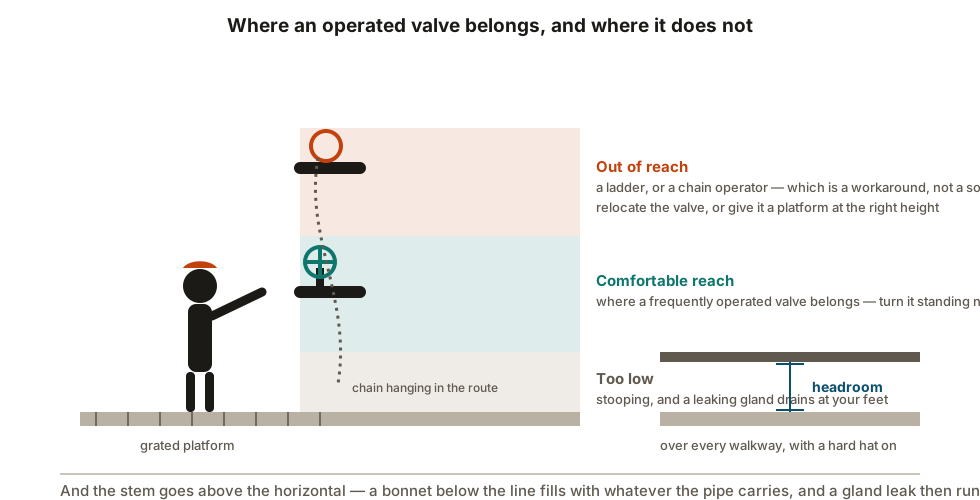
Height. A frequently operated valve belongs within comfortable reach of a floor, grade or platform. Project standards put numbers on it; the principle is that an operator standing normally can turn it.
Orientation. The handwheel should not project into a walkway, and the stem should be above the horizontal. A stem pointing down puts the bonnet below the line, where it fills with whatever the pipe carries, and any packing leak drains onto the person operating it.
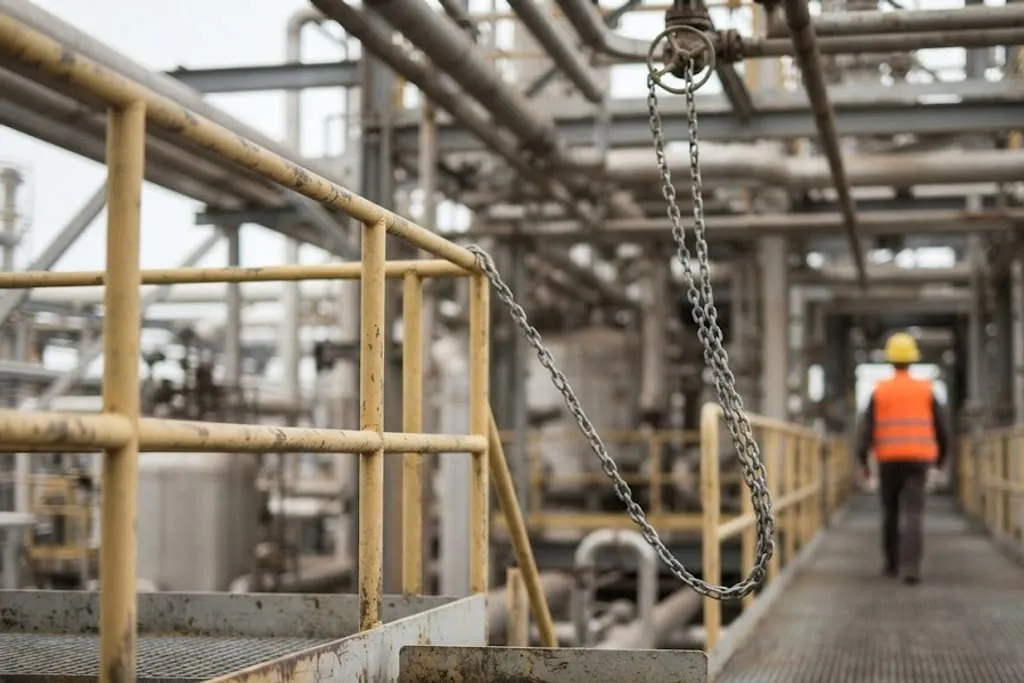
Chain operators.
Isolation points. A valve that cannot be safely reached cannot be used as a permit isolation point. Putting one somewhere awkward quietly makes everything downstream of it harder to work on for the life of the plant.
Platforms, ladders and escape
Two ways off anywhere people work. A platform with a single ladder at one end is a trap, and the second route has to lead away from the hazard rather than past it.
Caged ladders above a certain height, intermediate landings on tall runs, and platform width enough for someone to pass someone else carrying something.
Headroom. Over walkways, enough that a person wearing a hard hat does not meet a line. Over roads, enough for the vehicles and lifts that will use them — and that figure constrains rack elevation, so it has to be known before the rack is set.
Maintenance space
The question to ask of every item is simple: how does this come out, and to where?
- Exchanger bundles withdraw along the shell axis. The space needed is at least the bundle length, plus handling room, plus crane access.
- Pump rotors and motors need withdrawal space and a lift route.
- Filter elements, strainer baskets and internals need room above or in front to come out.
- Spool pieces let equipment be removed without cutting pipe, and they want to be in the design rather than improvised later.
- Drop-out areas — a defined clear space through which items at elevation can be lowered, kept free of piping, trays and structure.
- Davits and monorails over heavy items at height, relief valves especially, because those come off on a cycle for bench testing.
Instruments, drains and the operator round
If it cannot be read, it is not read. A gauge reachable only by climbing on pipework stops providing information, and nobody notices until something it would have shown goes wrong.
Transmitters need access for calibration. Sample points need a safe position, a safe height and somewhere for the sample to go. Drains and vents need to be reachable and to discharge somewhere that is not a walkway.
And the operator round is a route someone walks several times a day. It is worth tracing on the model: what they must see, what they must turn, and whether the path makes sense or doubles back three times.
Finding it while it is still cheap
Clash detection finds steel through pipe. It does not find the valve nobody can reach, the bundle that cannot be pulled, or the platform with one way off, because those are not geometric failures — they are failures against how people actually work.
What finds them is a model review with operations and maintenance in the room, at thirty, sixty and ninety per cent. See plot plan and equipment spacing.
What to take away
- Operability is judged after handover, and nearly all of it is decided before.
- Valves within reach, stem above horizontal, handwheel out of the walkway.
- A chain operator is a workaround; relocate or build a platform instead.
- Two ways off every platform, leading away from the hazard.
- Headroom over roads constrains rack elevation — settle it early.
- Ask of everything: how does it come out, and to where?
- Spool pieces, drop-out areas, davits are design items, not site improvisations.
- An instrument that is hard to read is not read.
- A valve that cannot be reached cannot be an isolation point.
- Model reviews with operations and maintenance are the only reliable way to find any of this.
Check your understanding
10 questions. Nothing is recorded — this is just for you.