
Piping
Section IX essential variables — what invalidates a procedure qualification
Why a WPS can be revised freely in some respects and requalified from scratch in others. Essential, non-essential and supplementary essential variables, the ranges a PQR actually qualifies, and the low-temperature trap that turns a harmless change into a requalification.
Standards referencedASME Section IXASME B31.3ASME Section II Part CAPI 577
Courses and site inductions name the three documents constantly — WPS, PQR, WPQ. Very few ever open the machinery underneath them, which is a shame, because that machinery is the whole of ASME Section IX and it answers the question an inspector is actually asked: this changed — does the qualification still cover it?
The three documents, and what each one proves
WPS — Welding Procedure Specification. The instruction to the welder. The recipe: process, material, filler, position, preheat, current, technique. It is a forward-looking document — do it this way.
PQR — Procedure Qualification Record. The evidence that the recipe produces sound metal. A coupon was welded, tested and the results recorded. It is a backward-looking document — this was done, and here is what came out.
WPQ — Welder Performance Qualification. The evidence that this individual can follow the recipe. Also backward-looking, and about a person rather than a method.
The variables, which are the whole subject
A PQR is a snapshot of one set of conditions. Production never matches it exactly. So Section IX sorts everything that might differ into three classes, by what the difference does to the finished metal.
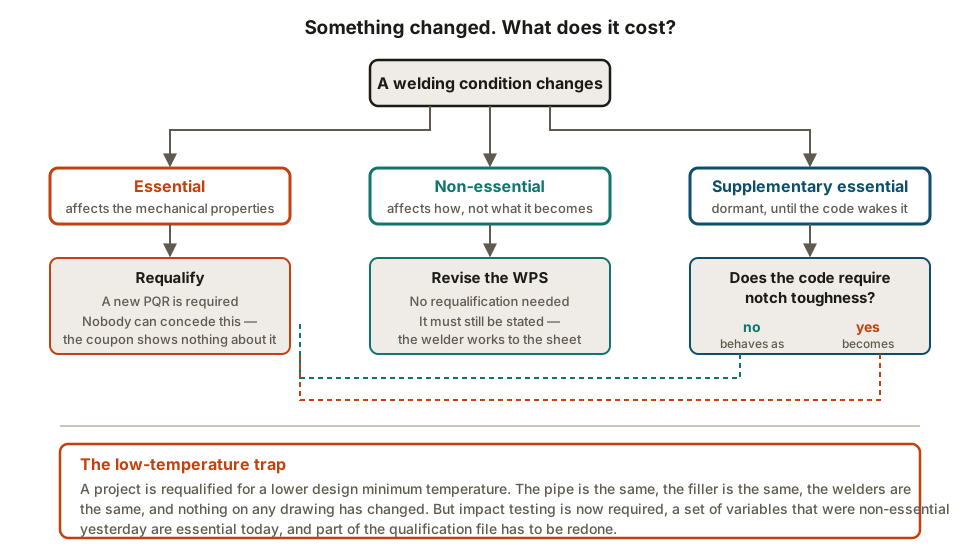
Essential
A change beyond the qualified range invalidates the PQR. A new qualification is required. These are the variables that change the mechanical properties of the joint — base metal group, filler metal group, a change of process, thickness outside the range, significant changes to preheat or post-weld heat treatment.
There is no route around this. A client cannot accept it, an inspector cannot concede it, and the fact that the welder is excellent is not relevant. The test coupon simply does not demonstrate anything about the weld now being made.
Non-essential
A change requires the WPS to be revised, and nothing more. These affect how the weld is made rather than what it ends up as — joint detail within limits, some technique variables, travel direction.
They still have to be stated on the WPS, because the welder works to it. “Non-essential” means does not require requalification; it does not mean does not matter.
Supplementary essential
The ones that catch people. These sit dormant and become essential when the construction code requires notch toughness testing.
Ranges, which is where real findings come from
A coupon does not qualify a value. It qualifies a band around that value, and the bands differ by variable.
- Thickness — a range with limits both above and below, derived from the coupon thickness.
- Diameter — a range, with small bore treated separately.
- Position — qualifying in one position may or may not cover others.
- Material — the P-number group rather than the individual grade.
- Filler — the F-number and A-number groupings.
P-numbers, F-numbers, A-numbers
Grouping is what makes qualification tractable. Without it, every grade would need its own PQR.
- P-number groups base metals of comparable weldability. Carbon steels sit together; the chrome-moly alloys occupy their own groups, sometimes with sub-groups where the differences matter.
- F-number groups filler metals by usability characteristics — how the electrode runs, broadly.
- A-number groups them by deposited chemical composition — what the weld metal actually turns out to be.
The two filler groupings answer different questions, and both appear in the rules for different reasons.
Welder continuity
A WPQ does not expire on a date. It lapses through disuse: the usual trigger is six months without using the process.
It is re-established by welding and testing, or by a documented record of the welder having used the process within the period. That record is the continuity register, and it is one of the documents most reliably out of date on a working site — which is why an expired ticket is typically discovered at the point where the weld has already been made.
See welder qualification and continuity.
What the inspector does before the first arc
A qualification review is a matrix, not a filing exercise:
- List the joints in the package — material, thickness, diameter, position, service.
- List the procedures offered, and for each, the ranges its PQR actually qualified.
- Map one onto the other. Every joint must be covered by a procedure whose qualification reaches it on every essential variable.
- Check the service requirements — impact testing, hardness limits, PWHT — and whether the supplementary essentials are live.
- Check the welders against the procedures and against continuity.
- Build the weld map, so that later a weld number leads back to a welder, a procedure and an examination.
Doing this after production has started means finding the gap in welds that are already in the line.
What to take away
- WPS instructs, PQR demonstrates, WPQ qualifies the person. A WPS with no PQR behind it demonstrates nothing.
- Essential means requalify. Non-essential means revise the WPS. Supplementary essential means essential, once the code calls for impact testing.
- The low-temperature trap: a datasheet change can invalidate procedures without anything physical changing.
- A coupon qualifies a range, not a value — and the real finding is usually a valid qualification used outside it.
- P-number for base metals, F-number for filler usability, A-number for deposited chemistry.
- Continuity lapses at six months of disuse, and the register is usually stale.
- The review is a matrix done before welding, not an audit done after.
Check your understanding
10 questions. Nothing is recorded — this is just for you.