
Piping
Reading a WPS and a PQR — what is on the sheet and what the tests proved
The practical document skill — what each field on a welding procedure specification is for, what a qualification record actually recorded, and what tensile, bend, impact, macro and hardness results each demonstrate about the joint.
Standards referencedASME Section IXASME Section II Part CASME B31.3API 577
Section IX essential variables covers the rules. This topic is the document skill that sits on top of them: picking up a WPS and a PQR, reading them against each other, and knowing what the test results at the bottom of the second one actually proved.
The WPS — the recipe
A forward-looking instruction to the welder. Everything on it is there because somebody has to do it, so it tends to read as a list of parameters with ranges.
| Section | What to look at |
|---|---|
| Joints | Joint design, backing, root spacing — and whether it matches the detail on the isometric |
| Base metals | P-number and group, thickness range, diameter range |
| Filler metals | SFA specification, AWS classification, F-number, A-number, size |
| Position | And progression — uphill or downhill matters |
| Preheat | Minimum, interpass maximum, and how it is maintained |
| PWHT | Temperature range, time, heating and cooling rates |
| Gas | Shielding, backing, flow rates |
| Electrical | Current, polarity, amps, volts, travel speed — usually as ranges |
| Technique | Stringer or weave, cleaning between passes, single or multi-pass |
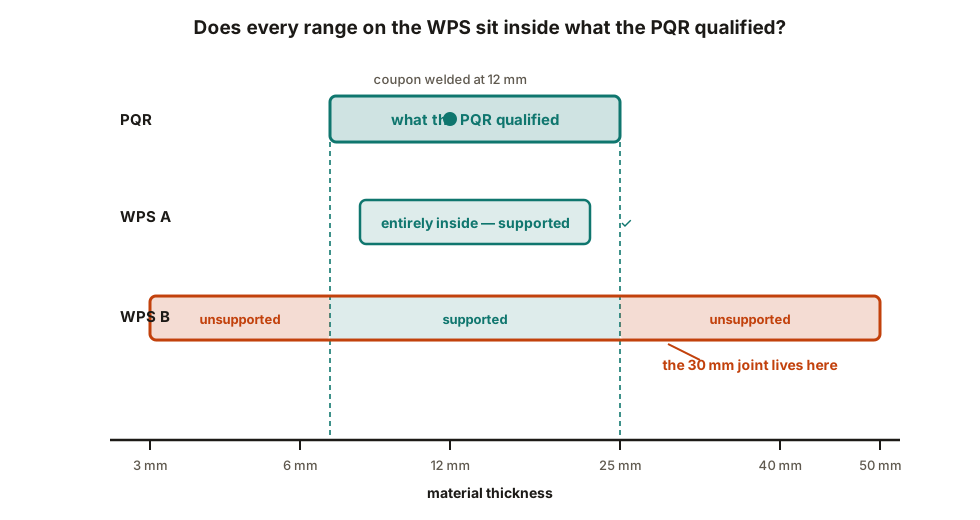
Ranges are normal. A WPS exists to cover production, not one coupon. What matters is whether each range sits inside what the evidence supports.

The PQR — the evidence
Backward-looking. It records what was actually done on one coupon, as single values rather than ranges, and what the tests found.
Two things on a PQR are routinely misread:
- Thickness. The PQR states the coupon thickness — a fact. The WPS states the production range — a claim about what that coupon licenses. The rules converting one to the other are in Section IX, and this is the single commonest place a procedure reaches further than its evidence.
- Signature. The organisation certifies that this is a true record of what was welded and tested. It belongs to whoever performed the qualification, which is why a PQR cannot be adopted from another company along with their WPS.
What the tests proved
The results table is the part most people skip. Each test answers a different question.
Transverse tensile. Pull a specimen across the joint. Acceptance normally requires reaching the specified minimum tensile strength of the base metal. A break in the parent metal rather than in the weld is the clearest possible pass — it means the joint was not the weakest thing present.
Guided bend. Bend a specimen over a former so the surface is heavily strained. A sound, ductile joint takes it without opening. Cracks, lack of fusion and trapped slag reveal themselves as the face stretches. This is a soundness and ductility test, not a strength one.
Impact (Charpy). Required when the construction code calls for notch toughness, which usually means low design temperature. It measures energy absorbed in fracture — resistance to brittle failure. It also brings the supplementary essential variables alive, which can invalidate procedures that were entirely valid the day before.
Macro examination. Polish and etch a cross-section. You see fusion, penetration and profile — whether the root fused, how far the heat-affected zone reaches, whether the passes tied in. The cheapest direct look inside the joint.
Hardness survey. Required where the service limits it — sour service above all. Hardness is the proxy for susceptibility to sulphide stress cracking, and the heat-affected zone is where an uncontrolled weld leaves a hard region. See material degradation.
The findings that recur
What to take away
- The WPS instructs forward with ranges; the PQR records backward with values.
- First check: every WPS range inside what the PQR qualified.
- The PQR’s thickness is a coupon fact; the WPS’s is a claim about what it licenses.
- Tensile for strength, bend for soundness and ductility, impact for brittle resistance when the code asks, macro for fusion and profile, hardness where the service limits it.
- A PQR certifies a true record, and belongs to the organisation that performed it.
- A WPS whose PQR cannot be produced is unsupported, however complete it looks.
Check your understanding
10 questions. Nothing is recorded — this is just for you.