Piping
Expansion joints and bellows — pressure thrust and why they are the last resort
What a bellows can and cannot absorb, the pressure thrust that dwarfs the thermal force it was fitted to relieve, tied and hinged and gimbal arrangements, guide spacing, cycle life, and the installation errors that kill them early.
Standards referencedEJMAASME B31.3ASME B31.1MSS SP-58
Expansion loops and offsets ends with a ranked list of what to do when the loop does not fit, and the expansion joint is fifth on it. This topic is why it is fifth, and what you have to get right if you reach for one anyway.
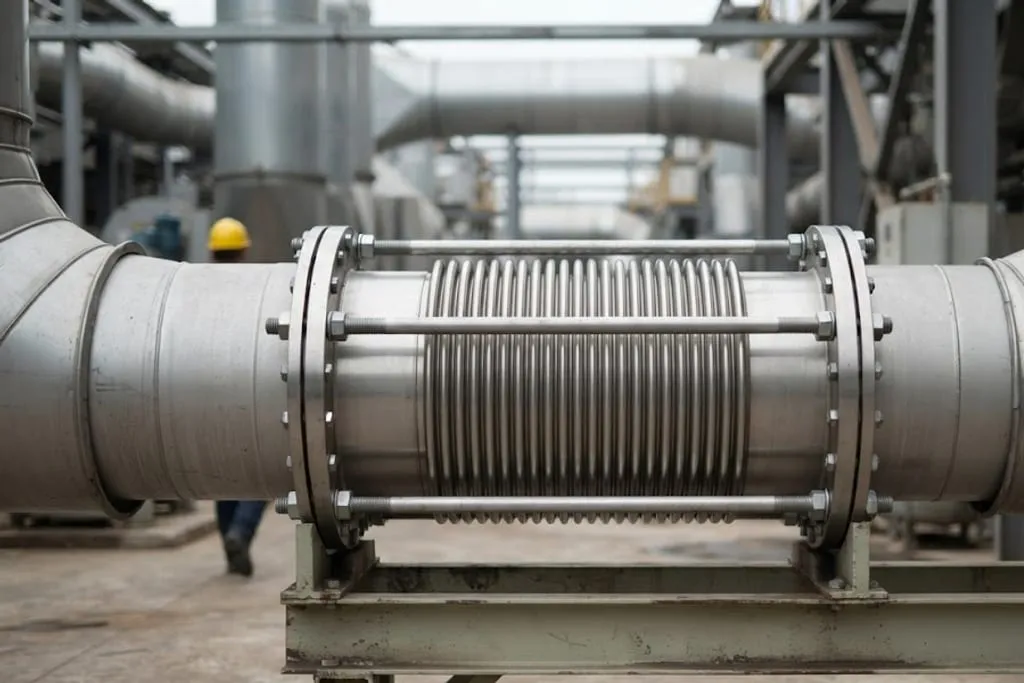
A bellows is a deliberate flexible break in a pressure envelope. That sentence contains both the capability and every problem that follows from it.
What a bellows is
Convolutions formed from thin sheet, typically austenitic stainless, often in two or more plies, with each ply measured in fractions of a millimetre. The thinness is not economy — it is the flexibility. A convolution thick enough to feel reassuring would not move.
It absorbs three kinds of movement, and they are not equally easy:
- Axial — compression and extension along the pipe axis. What a plain bellows is best at.
- Lateral — one end offset sideways from the other. Needs either two bellows in a unit or a tied arrangement.
- Angular — one end rotated relative to the other. What a hinge uses.
The rated capability for each is in the manufacturer’s data, it is a budget, and combined movements consume it faster than any one alone.
Pressure thrust, which is the whole subject
This is the fact that catches people, including people who have specified bellows before.
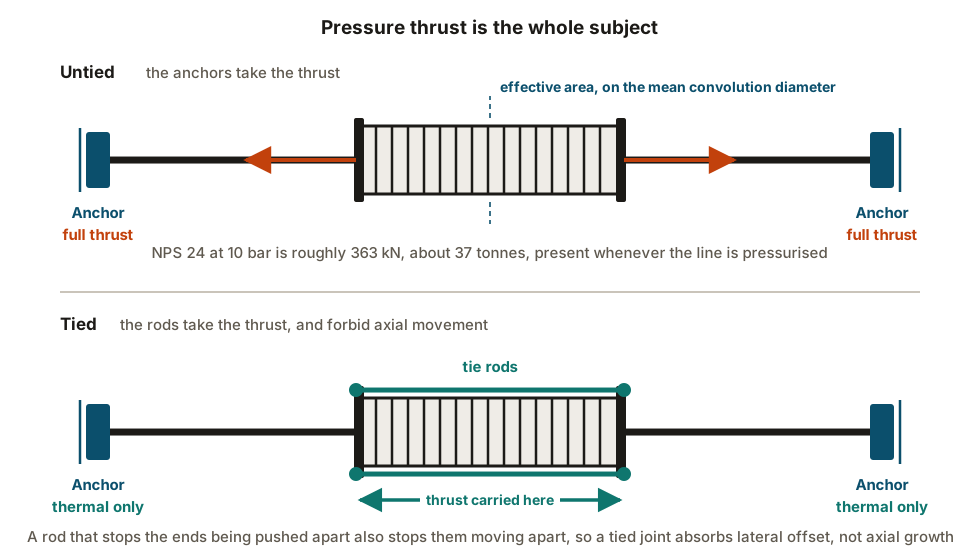
Because the bellows is a flexible break in the envelope, internal pressure acts on it exactly as it acts on a blind flange — pushing the two ends apart. The force is the pressure times the effective area, which is based on the mean diameter of the convolutions and is therefore appreciably larger than the bore.
Take an NPS 24 line at 10 bar with a mean convolution diameter of about 680 mm:
A_eff = π/4 × 680² ≈ 363,000 mm²
F = 1.0 MPa × 363,000 mm² ≈ 363,000 N ≈ 37 tonnesThis is why an unrestrained bellows is a decision about the anchors, not about the pipe. If the anchors and their structure cannot take the thrust, the joint type has to change.
The four arrangements
Unrestrained (single bellows). Takes axial movement. The system anchors take the full pressure thrust. Cheapest joint, most expensive anchors.
Tied. Tie rods across the joint carry the thrust, relieving the anchors. But a rod that prevents the ends being pushed apart also prevents them moving apart for any other reason — so a tied single bellows absorbs lateral offset, not axial growth. Fitting one where axial movement was needed is a common and costly misreading of a catalogue page.
Hinged. Pins carry the thrust and the joint rotates about one axis. A single hinge absorbs angle only, so they are used in sets of two or three along a leg, letting the leg articulate to take up the growth.
Gimbal. Two hinge axes, so angular movement in any plane, thrust carried by the gimbal ring. Used where a three-dimensional route has to articulate.
Pressure-balanced. An additional bellows and linkage arranged so the thrust is reacted internally, presenting almost none to the anchors. The expensive answer, and the one that is genuinely right at a sensitive equipment nozzle where no other option exists.
Guides, and the strut you have just created
A pressurised line containing an axial bellows behaves like a column in compression — the thrust is trying to push it apart, and the pipe between the anchors is what resists. An unguided column buckles.
EJMA’s guidance is specific and worth carrying in your head: the first guide within about four pipe diameters of the joint, the second within about fourteen, and conventional spacing beyond that. Guides near a bellows are not a detail to be relaxed when a support clashes with something — they are what stops the line folding sideways.
How bellows actually fail
Fatigue. The convolutions are thin and the duty is cyclic. A joint rated for a thousand cycles is rated for a thousand, and a line that cycles daily reaches that in under three years. Cycle life is a specified quantity, not a characteristic of bellows in general.
Squirm. Column instability of the convolutions themselves under internal pressure — they lean out of square rather than staying stacked. A pressure limit, not a movement limit, which is why an over-enthusiastic hydrotest can destroy a joint that never moved.
Corrosion. A ply measured in tenths of a millimetre has no meaningful corrosion allowance, and the convolution roots are where condensate, deposits and chlorides collect. Metal loss that pipe would ignore for a decade perforates a bellows.
Erosion and deposits. Hence internal liners or sleeves on flowing service — and hence the rule that a liner has a flow direction, which has to match the line.
Over-compression at installation. The joint is set to a cold position that assumed a particular installed gap. If the gap came out different and the joint was squeezed to suit, it has already spent part of its travel.
Installation, which is where most of them are lost
Three more that recur:
- A bellows is not an alignment tool. Taking up a fabrication misalignment spends movement that thermal growth has already been allocated, and leaves the joint permanently off-centre.
- Welding near it. Spatter on a thin ply is a defect, and a bellows is normally protected or removed during adjacent hot work.
- Insulation and inspection. Insulating over a bellows hides the one component on the line that genuinely needs looking at. Where it has to be insulated, it needs a removable box.
Where a bellows is genuinely right
Large diameter, low pressure, no room, no alternative — flue gas and process duct, turbine exhausts, condenser necks, FCC lines, and the occasional pressure-balanced unit protecting a nozzle that nothing else can protect. In those places the thrust is manageable, a loop would be absurd, and the joint earns its inspection burden.
Everywhere else, it is the option you take when the four above it have been tried and written down. See anchors, guides and restraint schemes for what the anchors are then being asked to do.
What to take away
- A bellows is a flexible break in the pressure envelope, and everything good and bad about it follows from that.
- Pressure thrust is the subject. Pressure times effective area, and it routinely dwarfs the thermal force the joint was fitted to relieve.
- Tied means lateral. Tie rods relieve the anchors and simultaneously forbid axial movement.
- Hinges and gimbals come in sets, because one absorbs angle rather than length.
- Guide it closely — about four diameters to the first guide, fourteen to the second — or the thrust buckles the line.
- Cycle life is a number, and it is spent by the duty rather than by time.
- Thin plies have no corrosion allowance and the roots are where the deposits sit.
- Shipping bars come out after the anchors go in, and never to make a bad gap fit.
- Genuinely right on large, low-pressure duct. Last resort everywhere else.
Check your understanding
10 questions. Nothing is recorded — this is just for you.