
Piping
Site records and the daily diary — writing for somebody who will not believe you
Why the site diary is the most valuable document a supervisor produces, what distinguishes an entry that is evidence from one that is worthless, what to record every day regardless, and why contemporaneous matters more than detailed.
Standards referencedISO 21508
The site diary is the most valuable document a supervisor produces, and it is usually the one treated with least care. It takes ten minutes a day. It decides, sometimes years later, who pays for what.

The reason it is undervalued is that its payoff is invisible for a long time and then arrives all at once, usually in a room full of people who were not there.
Write for a stranger who does not believe you
Not because anybody is dishonest. Because by the time a record matters, the people involved have moved on, the memories that remain have diverged honestly, and the only thing still in the room is what was written down on the day.
That reader has no context, no relationship with the writer, and no reason to extend the benefit of the doubt. Writing for them is the whole discipline.
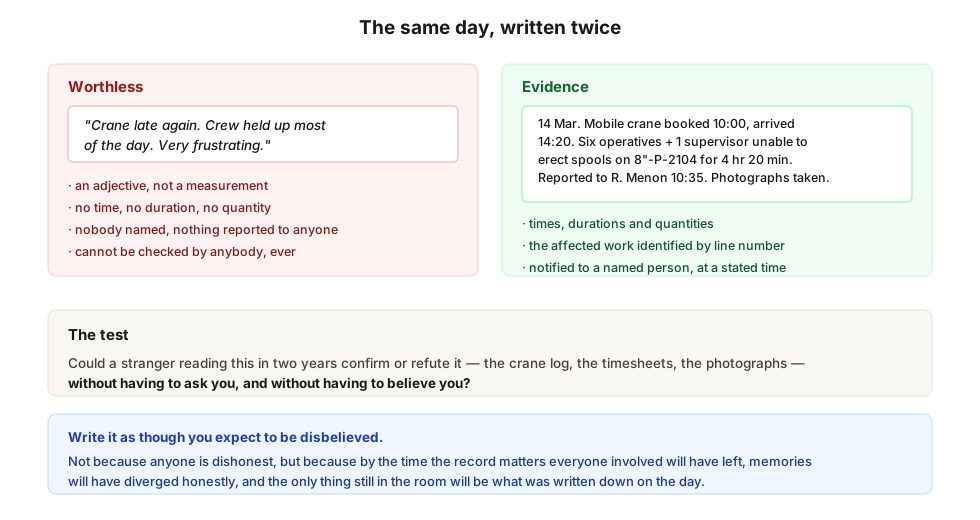
What makes an entry evidence
Four properties, and an entry with all four is worth more than a page of narrative without them.
It is measurable. Times, durations, counts, line numbers, quantities. “Most of the day” is not a duration. “4 hr 20 min” is.
It names people. Who was affected, who was told, who instructed what. A name converts an event into something another person can be asked about.
It identifies the work. By line number, spool mark, area. Not “the piping in unit 3”.
It is checkable against something else. Crane logs, timesheets, delivery notes, gate records, photographs. The strength of a record comes from corroboration, and corroboration is only possible if the entry contains things that other documents also contain.
Contemporaneous beats complete
A short entry written on the day beats a thorough reconstruction written a month later, and by a wide margin.
The reason is credibility rather than accuracy. A record made before anybody knew it would matter is treated quite differently from one assembled afterwards by a person with an interest in the outcome — however scrupulously honest the second one is.
This has a practical consequence. Ten minutes at the end of every shift, done badly, is worth more than an hour at the end of the week done well.
What goes in every day
The routine content, recorded whether or not anything happened:
| Item | Why |
|---|---|
| Labour on site, by trade | The basis of every delay and disruption discussion there will ever be |
| Areas and lines worked | Establishes where the crew actually was |
| Weather | Only matters on the day it matters, and by then it is too late to start |
| Deliveries and shortages | A missing item recorded on the day it was missing |
| Instructions received, and from whom | Verbal instructions are real and evaporate unless written |
| Access, permits, isolations | What was available and what was not |
| Anything that stopped work, with times | The core of it |
Photographs
Cheap, fast, and underused.
A photograph records a condition that would otherwise have to be described, disputed and remembered. It carries a timestamp. It shows the things nobody thought to mention.
Two habits make them useful rather than merely numerous:
- Photograph the context as well as the detail. A close-up of a damaged bevel proves nothing about where it was.
- Reference them in the written entry. A folder of ten thousand photographs nobody can navigate is not a record. “Photographs taken” in the diary entry, with the date, is what makes a particular one findable.
Verbal instructions
The single most common gap in site records.
Instructions given verbally are real, are acted on, and are frequently denied later — again, usually honestly, because the person giving them did not think of it as an instruction.
The fix is a habit rather than a confrontation: record it in the diary, and where it carries cost or changes scope, confirm it in writing the same day. “Further to our discussion this morning, we have moved the crew to line X as instructed.” That is not an accusation. It is a record, and it is almost never disputed at the time, which is exactly why it works.
Check your understanding
6 questions. Nothing is recorded — this is just for you.