HSE
Energy isolation and lock-out — proving dead, not assuming it
Why a closed valve is not an isolation, what a personal lock actually protects, the energies people forget because they are not electrical, and why the return to service kills as often as the isolation does.
Standards referencedISO 45001IEC 60364-6
A plant is full of things that will move, flow, burn or shock if given the chance. Isolation is how that chance is removed before somebody puts their hands inside — and the difference between isolation and merely switching something off is the whole subject.
Off is not isolated
A switch in the off position, a valve wound shut, a breaker racked out: each of these makes the equipment safe for now. None of them makes it safe for somebody working on it.
An isolation is a position that has been secured, proved and cannot be reversed without the person at risk knowing about it. Those three words are the subject.
The energies people forget
Electrical isolation gets attention because it is taught. The others kill just as effectively and are missed more often.
- Pressure — process fluid, steam, instrument air, hydraulics
- Stored pressure — accumulators, receivers, a length of line between two closed valves
- Gravity — a raised load, a counterweight, a valve gate that will drop
- Springs — an actuator spring is holding hundreds of kilograms of force with the machine dead and quiet
- Thermal — surfaces hot enough to burn hours after shutdown, and cryogenic ones cold enough to do the same
- Chemical — residue in a vessel that reacts with air or water
- Mechanical — a flywheel, a fan windmilling in a duct, a conveyor that will run backwards under its load
- Radiation — a nucleonic level gauge whose source is still in its holder
The hierarchy of isolation
Not all isolations are equal, and the right one depends on what is being done and for how long.
| Single valve | One closed valve | No — a passing valve gives no warning | Operational isolation only, never for entry or breaking containment |
|---|---|---|---|
| Single block and bleed | One closed valve with a small bleed downstream of it | Partly — an open bleed shows whether the valve is passing | Short-duration low-hazard work, where the standard allows |
| Double block and bleed (DBB) | Two closed valves in series with a bleed between them | Yes — the bleed between them vents any leak past the first valve | The normal standard for breaking into hydrocarbon lines |
| Double isolation and bleed (DIB) | Two valves each independently capable of sealing, plus a bleed | Yes, with redundancy — either valve alone is a full isolation | High hazard work, long duration, or high pressure differential |
| Spade or spectacle blind | A solid steel plate bolted into the line | Yes — and you can see it from the ground | Vessel entry, long shutdowns, anything requiring positive isolation |
| Physical disconnection | The spool piece removed and the open ends blanked | Absolutely — there is no longer a flow path | The strongest isolation available; used for the highest-hazard work |
No rows match that filter.
A closed valve is not an isolation. It is a valve that happens to be shut, and it can pass, be opened by someone else, or fail. The strength of an isolation is judged by what happens when one element fails — which is why the strongest methods put a physical, visible barrier in the line.
Single valve is the weakest and suits only short, low-hazard work where the consequence of a pass is tolerable.
Double block and bleed puts two valves in series with a vent between them. The bleed is the intelligent part: leave it open and any leak past the first valve goes to the vent rather than building up behind the second. An open bleed also gives you something to watch — if it keeps flowing, the first valve is passing and you know before you open anything.
Positive isolation means a physical break: a spectacle blind swung to the blind side, a spade inserted, or the spool piece removed entirely. Nothing passes a plate of steel. For vessel entry, hot work, or anything running across shifts, this is what is used.
Lock, tag, and what each is for
The lock physically prevents the isolation being reversed. The tag says who fitted it, when, and why. They are not alternatives — a tag alone relies on somebody reading and obeying it.
Proving dead
An isolation you have not tested is an isolation you are trusting.
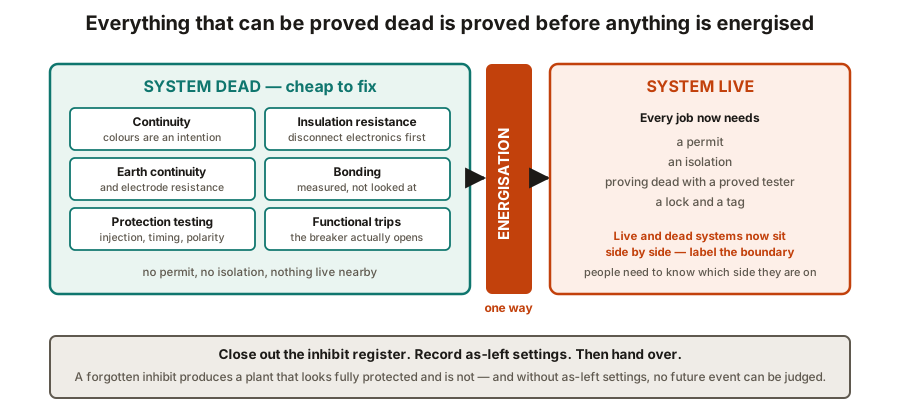
For electrical work the sequence is fixed and the order matters:
- Prove the tester on a known live source
- Test the conductors — all of them, in every combination
- Prove the tester again on the known live source
The same thinking applies to process isolations. Open the bleed and watch. Crack a flange under control before pulling it fully. Confirm the vessel is at atmospheric pressure at a point you can see, not at a gauge on a panel somewhere else.
Going back is the dangerous half
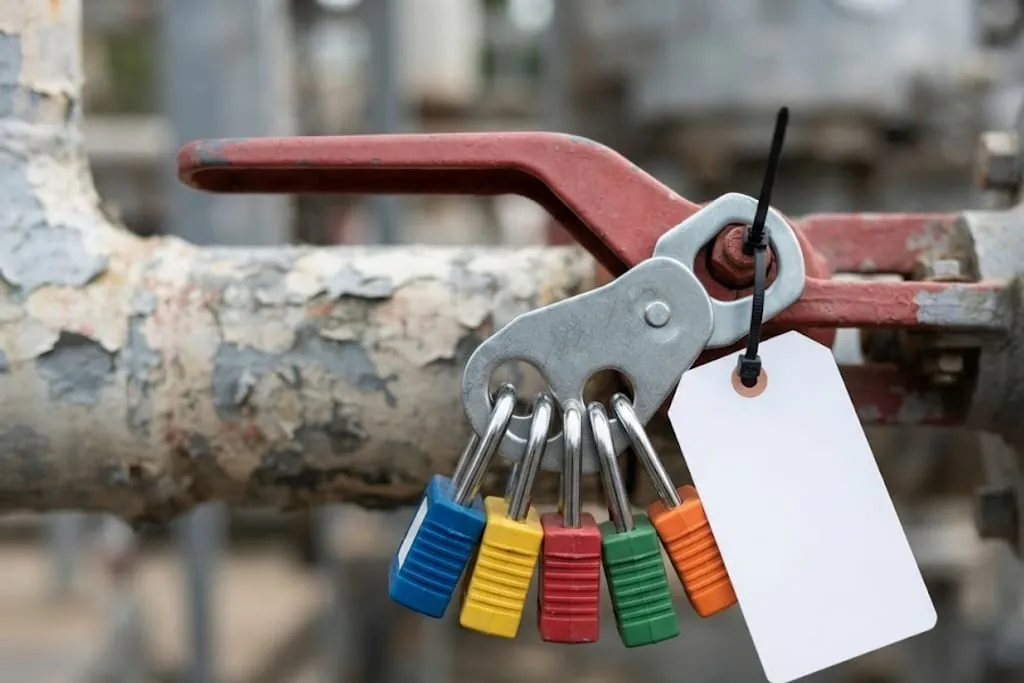
Everyone concentrates on the way in. The way out is where people are hurt.
Where this connects
The isolation is the physical half. The permit to work is the organisational half that records who decided it was safe, who verified it, and who accepted the risk. Neither works without the other: a permit describing an isolation nobody fitted is paperwork, and an isolation nobody recorded is a trap for the next crew.
What to take away
- Off is not isolated. Secured, proved, and not reversible without the person at risk knowing — those three things make an isolation.
- Electrical is one energy among many. Pressure, stored pressure, gravity, springs, heat, chemical residue, mechanical inertia and radiation all need releasing in their own right.
- Double block and bleed works because the bleed is open and can be watched.
- Positive isolation — a blind, spade or removed spool — is what entry and hot work get, because a plate of steel cannot pass.
- A personal lock protects the person holding the key, and they remove it themselves.
- Prove the tester, test, prove the tester again. A dead reading from a dead instrument looks identical to safety.
- De-isolation is the dangerous half. Reverse order, same discipline, and the blind count must balance.
Check your understanding
7 questions. Nothing is recorded — this is just for you.